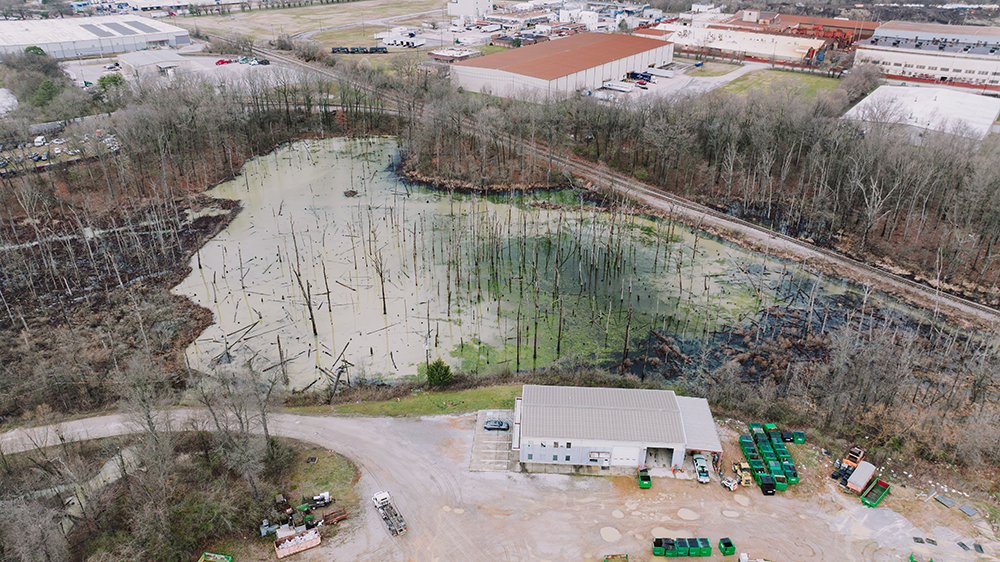
After I received my Celiac Disease diagnosis, my extended family underwent genetic testing to determine if they also carried the Celiac gene. The tests identified my mom as a carrier, but neither of her parents possessed the gene. My mom joked that she likely developed a mutation after growing up next to the “Monsanto plant” in Springfield, Massachusetts. This one-off quip likely carries more significance than my mom could have ever imagined, as the legacy of Monsanto’s environmental contamination is alive and well in the state of Massachusetts. Monsanto was notorious for its skirting of regulations meant to safeguard the public from environmental contamination, and its surviving subsidiaries are likely to follow a similar pattern with the new face of environmental pollution: forever chemicals.
Monsanto and the Shadow of PCB Production
Monsanto began operating in the Indian Orchard neighborhood of Springfield after its acquisition of the Fiberloid Corporation in 1938, and formed Solutia Incorporated as a subsidiary for its plastics production in 1997. Solutia was later acquired by the Eastman Chemical Corporation in 2012, although the Indian Orchards location remains colloquially known as the Monsanto plant by Springfield locals. Shaking the Monsanto legacy in Massachusetts remains difficult due to the company’s ongoing lawsuits associated with their production of polychlorinated biphenyls, or PCBs.
Monsanto began producing PCBs in 1929 up until their manufacturing was banned by the Environmental Protection Agency (EPA) in 1979 due to their carcinogenic effects and links to adverse immune, endocrine, and neurological outcomes. Despite this ban, PCB contamination remains persistent in historic dump sites. One such location is the Pittsfield-Housatonic River Superfund Site in Western Massachusetts, where General Electric (GE) disposed of PCBs provided by Monsanto and their former subsidiaries, Solutia and Pharmacia. Today the global corporation Bayer, which acquired Monsanto in 2018, has assumed all of Monsanto’s legal liabilities. Bayer (Monsanto) is similarly complicit in the active New Bedford Harbor Superfund Site. In addition to Superfund Sites, the company was held liable for PCB contamination in the Mystic River in Everett, MA.
GE is currently undergoing EPA-mandated cleanups of areas along the Housatonic, but residents of Berkshire County are seeking greater remediation. In 2024, the town of Lee filed a civil suit against GE, Bayer (Monsanto), Solutia, and Pharmacia alleging that their disposal of PCB-contaminants within Lee presents a public nuisance to town residents. Additionally, they allege that a 1972 agreement between Monsanto, its subsidiaries, and GE on the distribution of PCBs between the parties (despite their knowledge of the inherent dangers to human and environmental health) constitutes an intentional infliction of harm. Lee is seeking compensatory and punitive damages from Bayer (Monsanto), its subsidiaries, and GE in this ongoing trial. Several states have launched similar lawsuits seeking PCB-related environmental remediation from Bayer (Monsanto), with Oregon, Pennsylvania, and Illinois successfully securing multi-million dollar settlements.
Solutia’s historic production, distribution, and contamination of PCBs extends to their Springfield location. In 1981, The Valley Advocate newspaper reported Monsanto workers’ concerns that improperly stored waste on the Springfield property, including PCBs, was leeching into the Chicopee River. In a hazardous waste fact sheet prepared by the Department of Environmental Protection (MassDEP) in 2014, Solutia was listed as storing wastes containing PCBs in concentrations greater than 50 parts per million on site. For reference, the safe level of PCBs in drinking water is listed as 0.0005 parts per million by the EPA.

The storing of PCBs in waste is cited by the 2004 Stockholm Convention, a global treaty formed to tackle the risks posed by Persistent Organic Pollutants (POPs) such as PCBs, as an insufficient protectionary measure due to the risk of leakage into the surrounding environment. The Springfield plant’s alleged PCB contamination is hardly as extreme as that observed in Berkshire County. Rather, these observations highlight Solutia’s widespread disregard for human and environmental safety in the state of Massachusetts in the absence of strictly-enforced regulations.
Goodbye PCBs, Hello PFAS
If PCBs were one of the hallmarks of environmental contamination from unregulated industry in the 20th century, polyfluoroalkyl substances, or PFAS, are likely to characterize that of the 21st. Both chemicals are classified as “Persistent Organic Pollutants” or POPs under the Stockholm Convention due to their long-lasting nature, wide environmental distribution, and toxicity to humans and the environment. PFAS are valued for their water and heat-resistant properties and broad consumer and industrial applications. This utility, however, has led to a mass exposure and buildup of PFAS, also known as “forever chemicals,” in humans, wildlife, and agriculture that is beginning to be recognized by government agencies.
The U.S., as an observing member, is not legally bound by the Stockholm Convention and has instead implemented its own policies regarding PFAS. In 2023, the EPA required persons who had manufactured PFAS or PFAS-containing materials since 2011 to report PFAS production, volume, and disposal under the Toxic Substances Control Act. The following year the EPA established National Primary Drinking Water Regulations (NPDWR) to set the enforceable Maximum Contaminant Levels (MCL) for six PFAS in drinking water at 4.0 ng/L, with a trigger level prompting quarterly testing set at 2.0 ng/L. MassDEP’s 2020 PFAS limitation of 20 ng/L was subsequently superseded by the more stringent regulation. Such progress is promising on the surface, but the EPA has shown its hesitancy to enforce PFAS regulations by extending the MCL compliance date from 2029 to 2031.
In a public notice on Solutia’s 2025 permit application to Discharge Pollutants to Surface Waters in the Chicopee River, MassDEP expressed concerns over Solutia’s potential PFAS contamination. A draft of the permit contains a requirement that Solutia conduct and report quarterly effluent tests for 40 PFAS in accordance with EPA regulation, but the publicly-available database supposedly housing said reports does not contain any data on Solutia.
MassDEP’s concerns over Solutia’s handling of PFAS are best mirrored by earlier recording of PFAS levels, likely prompted by MassDep’s 2020 PFAS regulations, in the Chicopee River segment where Solutia discards its effluent. The New England Water Science Center recorded 64 samples of chemicals within the PFAS family in 2020, with none of the samples being above the 4.0 ng/L regulations in place today. Nine samples, however, contained PFAS concentrations over the 2.0 ng/L trigger level. These levels indicate that a level of PFAS now designated as warranting increased water quality monitoring were present. Trigger level regulations cannot be retroactively used to justify increased monitoring of Solutia’s activity, but do lend credibility to MassDEP’s concerns over Solutia’s handling of PFAS.
U.S. Regulations from an International Perspective
The U.S. is not the only country marred by the presence of PFAS. The Stockholm Convention has been ratified by 152 countries, indicating that the international community recognizes the threat posed by PFAS contamination. Several countries are leading the way in terms of PFAS regulation and consumer protection.
The European Union (EU) instituted POP Regulations in 2019 which either banned or restricted the production and trade of POPs in the EU market. A more stringent regulatory framework which specifically designates all PFAS as non-threshold substances, or chemicals in which there is no safe level of exposure, is currently in discussion for potential ratification in 2027. This would place substantial pressure on other Stockholm Convention signatories to implement similar stringent restrictions.
Australia implemented a similar ban on the import, export, or production of three PFAS in 2025 due to their ability to cause irreversible harm to the environment. Although this regulation is less encompassing than the universal ban proposed by the EU, it suggests the gravity with which countries are treating the environmental effects of PFAS.
Like the U.S., the EU and Australia have both introduced contaminant level limitations on PFAS. The EU set a limit of 0.1 ug/L, or 100 ng/L, for 20 PFAS in 2026, and Australia set a limit of 200 ng/L for PFAS in 2025. Surprisingly, these limits are significantly higher than the U.S. limit of 4.0 ng/L. While the U.S. has failed to take adequate action regarding the trading of PFAS in comparison to other countries, it appears to be on the forefront of contaminant level regulation.
Strict contaminant level regulation doesn’t abstain the U.S. and PFAS-storing companies like Solutia from scrutiny. This regulatory gap between the U.S. and international community merely demonstrates the global failure to meaningfully address existing PFAS contamination. Banning the production and trade of future PFAS is necessary to regulate commercial activity, but fails to address the harm existing PFAS pose to human and environmental health. Countries must target existing contaminators like Solutia in order to remedy existing harm.
Can a Tiger Change its Stripes?
If Solutia’s response to PCB regulation is any indication, one would expect the company’s compliance with increasingly stringent PFAS regulations to be lackluster at best. If Solutia complies with the EPA’s mandatory conducting and uploading of effluent tests for PFAS, Springfield residents can begin to assess the danger posed by interacting with their environment. The Chicopee River is a popular site for public recreation, so the repercussions of PFAS contamination could be severe. Until then, Solutia’s Springfield location is able to shroud itself in mystery as larger polluters receive the brunt of the public's attention and outrage.
In regards to my moms original theory, NYU Langone recently identified a connection between PFAS contamination and the onset of Celiac Disease in young girls. While there’s no way to know the extent to which Solutia influenced my diagnosis, one only needs to reflect on their past culpability to reasonably assign blame.
____
Ava Lashgari received her B.A. in International Studies from American University and is interested in the intersection of human rights and the natural sciences.
The opinions and experiences presented in guest articles are those of the author, and do not necessarily reflect the views of the Center.


