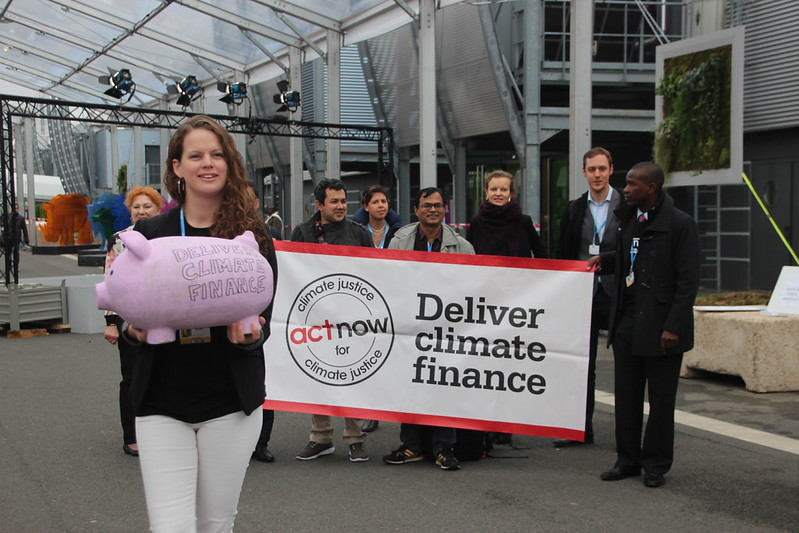
In October, Pakistan’s Prime Minister Shehbaz Sharif made a strong plea at the United Nations: “Loans over loans, adding to loans is not a solution.” He urged the international community to honour its commitments on climate finance and provide grants—not debt options—to vulnerable nations like Pakistan.
His words ring true. Debt-driven climate finance cannot address a crisis that has already drowned villages, destroyed livelihoods, and displaced millions. Pakistan, still reeling from the scars of the 2022 floods—which caused over US$30 billion in damage—now faces another worsening climate reality. Since late June 2025, unprecedented monsoon floods have affected more than 6.9 million people, displaced nearly 150,000, and destroyed 2.5 million acres of farmland in Punjab province alone. These floods—made more intense by climate change—have deepened food insecurity and shattered livelihoods nationwide.
Earlier this year, the Senate Standing Committee on Economic Affairs was informed that of the US$10 billion pledged for post-flood recovery at the Geneva donors’ conference, only US$500 million arrived as grants; the rest were structured as loans. Yet even where grants have been secured, outcomes on the ground remain worryingly weak.
Pakistan faces an urgent funding gap: it requires US$ 348 billion between 2023 and 2030 to cope with climate impacts, of which US$ 152 billion must go to adaptation and resilience, according to the World Bank. Current spending, however, covers barely six percent of this need, according to a report by UK International Development.
There are multiple, co-existing reasons for this failure. Many adaptation projects are designed top-down, with minimal involvement from the communities they are meant to protect. Even accessing climate funds is difficult, as complex application procedures, stringent fiduciary requirements, and limited technical capacity prevent local institutions from unlocking financing at the scale required.
Nowhere is this clearer than in Gilgit-Baltistan, where communities are once again facing devastating glacial lake outburst floods (GLOFs). The recent floods in Gilgit Baltistan wiped out forests, farmland, and livelihoods—despite millions of dollars spent under donor funded projects to build early warning systems and resilience.
On paper, the projects look promising. In reality, they have failed to deliver. Social media is full of heart-wrenching testimonies from residents who never received warnings, never saw local infrastructure built, and never felt safer despite years of funding. And critically, while these projects didn’t necessarily disrupt local communities, they also never meaningfully involved them. Residents were treated as beneficiaries, not stakeholders—leaving early warning systems unused, infrastructure mismatched to local needs, and the most at-risk groups, especially women and low-income households, feeling both unheard and unprotected.
This raises a deeper question: Is this corruption, poor design, or supply-chain failure?
In truth, it is a mix of all three. Some projects suffer from procurement capture or diversion. Many others are simply poorly designed, driven by donor incentives rather than community needs. Others fail because there are no maintenance budgets, leaving equipment and systems to degrade after initial installation. The solution must therefore be dual: stronger anti-corruption and procurement transparency, and a redesign toward community-led, performance-based adaptation.
Adaptation is inherently local. Bangladesh’s Cyclone Preparedness Programme (CPP) shows what genuinely devolved disaster governance can achieve. Over decades, Bangladesh built a community-led early warning and evacuation system powered by 76,000 trained volunteers—half of them women—who go door-to-door, use simple flag systems, and communicate warnings in ways people actually understand. Combined with thousands of community-managed cyclone shelters, this volunteer-driven model has cut mortality from major cyclones from hundreds of thousands to mere dozens. Crucially, it works not because of sophisticated technology, but because local people and not consultants own the system.
The lesson for Pakistan is clear: resilience fails when it is outsourced. It succeeds when institutions empower the people living closest to climate danger.
Yes, Pakistan deserves grants and reparations. The principle of climate justice demands it. But justice also demands that we use those funds wisely, efficiently, and equitably. Because the real tragedy is not just that the floods keep coming; it's that our people keep suffering the same losses, year after year, while billions flow through systems that fail them.
This is especially relevant as countries like Pakistan push for the operationalization of the Loss and Damage Fund—a historic financing mechanism established at COP27 in 2022 to support nations most affected by climate change disasters. The Fund is designed to help vulnerable countries recover from climate-induced losses that cannot be avoided through mitigation or adaptation, such as the destruction of homes, crops, and infrastructure. While its governing framework was adopted at COP28, questions remain over how the fund will be financed, accessed, and monitored. Initial pledges — under US$700 million globally — are nowhere near what’s required.
Meanwhile, adaptation finance is shrinking when it should be rising. The UNEP’s Adaptation Gap Report 2024 reveals that international public adaptation finance fell to US$26 billion in 2023, down from US$28 billion the year before—while developing countries need US$310–365 billion annually by 2035. This widening gap is dangerous: the less the world invests in adaptation now, the more it will be forced to spend on loss and damage later.
So what would it take for Pakistan to build climate governance that does not fail people every monsoon season? Accountability must be non-negotiable: every rupee of adaptation finance should be traceable via public dashboards, third-party audits, and legislative oversight to ensure money reaches those most at risk.
But Pakistan faces a deeper structural problem: it lacks a truly empowered third tier of government. While local councils exist, they often suffer from weak institutional capacity, corruption, and political interference, limiting their effectiveness. Even where local bodies are formally present, they need significant capacity-building and institutional strengthening if they are to deliver climate resilience programs. This is not just about money: Pakistan must simultaneously invest in building robust local institutions.
These reforms are vital because adaptation is inherently implemented by the public sector. On one hand, Pakistan needs more climate funds; on the other, it must build strong local institutions — the two are not mutually exclusive. Without this dual approach, adaptation projects risk being driven by outsiders and disconnected from the communities they’re supposed to serve.
There are real-world examples that demonstrate this approach works. For instance, Kenya’s County Climate Change Funds use local committees and independent auditors to track spending, with systems that succeed because communities shape priorities, independent bodies verify implementation, and the public can see where funds go.
Finally, all significant climate-adaptation projects in Pakistan must embed meaningful community participation and accessible grievance mechanisms to ensure accountability. But this only succeeds if the local government layer responsible for them is stronger, more autonomous, and genuinely accountable; a fix for one of Pakistan’s broadest and most persistent governance challenges.
Pakistan will continue to demand, rightfully, more grants, more climate justice, and more support from the world. But money alone cannot protect people unless our institutions can turn those funds into safety on the ground. Adaptation is delivered by local governments, yet Pakistan’s weakest link is precisely its local governance: underpowered, under-resourced, and too often undermined by corruption and political interference. Strengthening this tier is not optional; it is the foundation of resilience. Pakistan must pair increased climate finance with deep institutional reform: empowered local councils, transparent budgets, independent audits, and community-driven decision-making. Only then will every rupee translate into real protection and every flood into fewer tragedies.
Jawad Khalid is a climate finance specialist based in Islamabad, Pakistan. His work focuses on green innovation and climate-smart investments.


