Back in 2024, I was a final-year medical student, looking forward to a hopefully long, fruitful and fulfilling career as a doctor. Yet, like many young people, I found the very act of looking ahead into our collective future, with the knowledge of the current projections of global warming and climate destabilisation in the century ahead, very daunting. I began to wonder what our world, and our climate, may look like in forty-to-fifty years time, as my medical career draws to its eventual close. Having spent many hours reflecting on the complex intersection of climate activism and the healthcare industry, I sat down to interview doctors and practitioners that have undertaken protests with Health for XR (previously known as Doctors for Extinction Rebellion), a collective of doctors and healthcare professionals engaged in direct action for climate justice. I wanted to gauge their insights on environmental activism, and to reflect on where these actions sit within our collective responsibility to advocate for patient wellbeing.
I was intrigued by the factors that lead practicing doctors to engage so fervently with environmental causes. I was struck that the initial “lightbulb moments”, at which their consciousness on the issue of climate justice was first raised, were consistently ‘human’ in nature. They were catalysts that have occurred to many of us, medical professionals and non-medical professionals alike; such as reading the 2019 IPCC report, observing climate deterioration first-hand (both domestically and globally), or having challenging dinner-table-conversations with children.
However, if the factors drawing their attention to the crisis were external, it was often a sense of personal moral duty, derived from their professional experiences, that inspired these individuals to take direct action and raise public consciousness on the issue. “The climate crisis is a public health crisis” affirmed several interviewees, a statement backed up by evidence; an article published by the United Nations Development Programme in 2024 details how climate change is driving extreme heat-related deaths, how changes in global climate patterns are enabling disease-carrying vectors to survive in previously-uncharted regions, and how crop failure is giving rise to global food insecurity and thus malnutrition.
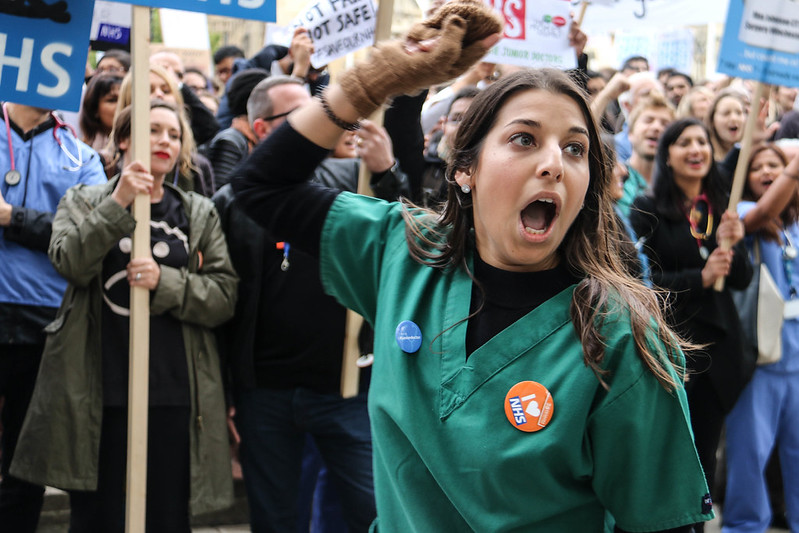
After taking up the mantle of this responsibility, and rationalising that taking action to help mitigate the climate crisis fell within their vocational duty, many of the interviewees started to look into productive mechanisms of climate protest. In turn, many of them decided that their activities needed to go beyond their clinic room. “I’d done a lot of research into what forms of activity/protest are effective”, said one of the doctors. “Nonviolent civil disobedience is the only route; recycling and voting are simply not enough”. And, for Health for XR, this nonviolent direct action has come in many shapes and sizes over the last six years, be it blocking bridges, founding climate choirs, going to die-ins, going to sit-ins, breaking glass at international finance corporations, or distributing ‘fact-checker’ leaflets outside the offices of major newspapers.
Of course, the image of healthcare professionals undertaking these kinds of evocative protests conjures up many additional questions. I was engrossed by how the experiences of doctors have differed from those of non-medical activists. Do doctors receive special treatment? Are they offered an authority not afforded to others? I was moved by an anecdote from one doctor:
“Why don’t you get a proper job?” came a voice from the onlooking crowd at a Health for XR protest at the Science Museum in the Summer of 2023, where activists voiced dissent against the institution’s fossil fuel sponsorship.
“She just said she’s a doctor!” another onlooker retorted from the crowd, “You can’t get a more proper job than a doctor!”.
When asked about their experience of arrest, the overriding response was that doctor-activists are generally treated cordially by police. One doctor said “they’re very used to arresting protestors. The station had five vegan options, more than most pubs in Britain.” When you attempt to unpick these broadly affable experiences, you spark a new, complicated discussion about the demographic of people that Health for XR, and this genre of activism more broadly, has been able to attract in the last half-decade.
“We’re mostly white and middle-class”, disclosed one doctor, rendering it difficult to disentangle whether any actual or perceived differences in treatment are attributable to the deference that we collectively and inherently bestow upon doctors, or if it relates to established inequalities in the treatment of minorities within the UK criminal justice system. Indeed, some evidence suggests that Indigenous populations are in fact subjected to more hostile or violent treatment when partaking in climate protest. A large-n quantitative analysis on environmental defenders, environmental conflict and environmental mobilization efforts conducted by Global Environmental Change found that rates of physical violence against, and criminalisation of, ‘environmental defenders’ significantly increases when Indigenous people are involved in this mobilisation.
During this demographic examination of healthcare professionals engaged in climate activism, one doctor offered the following insight: “people want to use their privilege, and we have the space and time to do so owing to said privilege. People who aren’t in that position can’t possibly be expected to take that risk”.
It is evident, however, that the choice to undertake nonviolent direct action carries significant consequences, whatever the individual’s background. It’s an often lonely and difficult lifestyle, balancing the double-whammy of a taxing career with one’s dread about our planet’s future. And despite the community and kinship that may be found through meeting like-minded, passionate individuals within protest groups, it can be a frightening prospect to raise one’s activism with colleagues in the workplace for fear of alienation.
Moreover, the decision to risk being arrested can carry severe implications for one’s professional livelihood. An article released by Novara Media in January 2025 cites that as many as 135 healthcare professionals have been arrested for climate protest in recent years. Indeed, in November 2025, we saw the first case of a working UK doctor being suspended from the UK medical register following arrest for actions undertaken in the name of climate protest. GP Patrick Hart, who had previously been sentenced for criminal damages incurred during a protest with Just Stop Oil in 2022, has been suspended from the UK medical register for a 10-month period after a tribunal hearing. The ruling of this case represents significant precedent for the future of Health for XR, and its membership; it makes it clear that involvement in direct action for climate justice can have significant, lasting implications for one’s medical career.
On the note of long-reaching impact, I concluded each interview by asking the activists about their optimism for our collective futures. The responses were predictably captivating, albeit disheartening. “I’ve had a policy of not talking to young people about my outlook”, one doctor told me. “I’m incredibly pessimistic. But my conscience doesn’t allow me to do nothing.”
“You need to know that you tried.” Was the response from another.
When asked about the tangible progress they were seeking through their advocacy, the interviewees cited many urgent, actionable goals: institutional divestment from fossil fuels, mandated sustainability training at medical teaching institutions, and the implementation of the Planetary Health Report Card at all health professional schools. But perhaps most thought-provoking of all is the recurrent feeling of wanting more help and engagement from friends and colleagues in rallying against the malignant enemy that is apathy. It’s clear that such dedicated involvement in climate activism takes a toll on one’s emotional well-being, and requires resolute strength of personal principles and the building of camaraderie. “Keeping friends engaged is hard; they ask a question or two but then the conversation changes, usually to where they’re flying on their next holiday. People even make jokes about it. Or about me.”
There is an understanding that many people are already at emotional capacity, or feel unable to become more involved for fear of arrest. But the interviewees stressed that even small actions make a significant contribution to the cause, be it signing the UK Health Professional template letter for the support of colleagues arrested for direct action, or joining the mailing list of grassroots organisations like the UK Health Alliance on Climate Change, Health Care Climate Action, or Health for XR itself.
When reflecting on the interview process, and what I’d learnt, I feel my sentiments are best expressed in one doctor’s words; “there’s this idea of emergence. Something happens and the Berlin wall comes down, or apartheid ends. A social tipping-point. We need a radical overhaul of hearts, minds and systems. But how that will happen… I simply don’t know.”
Henry Waddon is a doctor and writer from South Wales. He is a graduate of the University of Oxford, and enjoys writing at the intersection of urgent, complicated cultural issues. Author attests their piece was written without AI.


