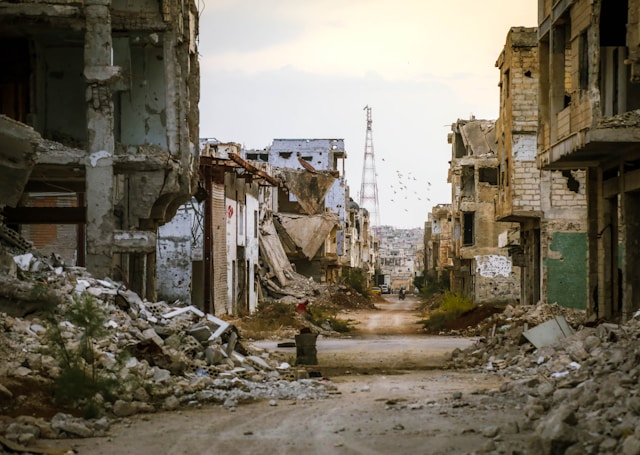
From the noxious plumes rising from the rubble in Gaza to the ammonia runoffs from shelled factories in Ukraine, war today is no longer just a geopolitical catastrophe–it is a climate change accelerant. Widespread deforestation, habitat loss, uncontrollable fires, and toxic spillovers into the soil, water, and air are only a few of war’s calamitous effects.
This is not an aberration of modern warfare. It is a common horrific thread observed throughout human history. The environment has long functioned as both a strategic target and instrument of war, its exploitation used to sustain military campaigns and break civilian resistance. Ancient Roman armies practiced vastatio, a scorched-earth tactic that involved burning fields, slaughtering livestock, and poisoning water sources to starve civilian populations and collapse local ecosystems. In 1970, biologist Arthur Galston decried the use of Agent Orange in Vietnam, where the powerful herbicide defoliated jungles and contaminated communities for generations. Today, the greenhouse gas emissions generated during the first two months of the war in Gaza exceed the annual carbon footprint of more than 20 of the world’s developing nations.
And yet, militarism remains conspicuously absent from our climate frameworks. Under the Paris Agreement, military emissions reporting is voluntary, and only a handful of nations submit partial data to the United Nations Framework Convention on Climate Change (UNFCCC).This omission isn’t merely incidental; it’s a deliberate blind spot. If the global military were a country, it would be the fourth-largest emitter of CO2 on the planet. The refusal of major powers, chief among them the U.S., to account for their military emissions allows some of the world’s largest polluters to operate with impunity and secrecy. The U.S. military alone has a carbon footprint larger than any other institution on Earth.
To wage war in the midst of a planetary crisis is to hone in on an extractive, sacrificial logic: that some lands can be destroyed, some people displaced, some ecosystems discarded. Dr. Farhana Sultana, an internationally recognized political ecologist and Professor in the Department of Geography and the Environment at Syracuse University, reminds us that climate injustice isn’t only about unequal emissions; it’s about how systems of colonial power are structurally reproduced under the guise of environmental progress.
The concept of “climate coloniality” describes the way dominant powers, frequently the purveyors of global conflict, displace the environmental costs of their emissions onto the Global South. These communities are forced to endure both the acute violence of war and the prolonged violence of climate change. In many contemporary conflicts, environmental devastation is engineered as part of the battlefield strategy in order to render enter regions utterly uninhabitable. Militarized violence often strikes communities already most vulnerable to climate disruption, including people displaced by droughts, crop failures, and increasingly frequent disasters, folding climate migration into yet another cycle of forced displacement shaped by U.S. foreign policy. Such tactics ensure that the destruction outlasts the conflict itself, entrenching displacement and deepening ecological rupture.
These are not only humanitarian emergencies. They are egregious acts of destruction committed against our environment with intergenerational consequences. If we are to confront the climate crisis with moral seriousness, we must disrupt the impunity with which war is ravaging our planet. That begins with three necessary shifts.
The First Shift. National militaries must be required to report their emissions to international bodies such as the UNFCCC. As Americans, we must demand that this change begin at home by ensuring that the Department of Defense (DoD)’s emissions data is transmitted to the UNFCCC with the rigor and transparency needed to establish a comprehensive global data baseline. Such disclosure requires basic financial accountability. The DoD has never passed a full audit, which means it cannot reliably account for how it expends public funds or how it generates its emissions. Bolstering both auditing and reporting is essential to bringing military pollution into the sphere of climate accountability. War cannot continue to exist in a climate blind spot.
The Second Shift. Environmental devastation wrought by war must be treated as a form of environmental injustice that demands redress. The damage to society does not end when the last bomb falls; it endures in poisoned waterways, scorched landscapes, and irradiated homelands. This calls for an internationally mandated body capable of measuring conflict-related environmental harm, quantifying losses, and assigning responsibility. Both the United Nations Environment Programme, which in 2009 urged the establishment of a permanent UN mechanism for assessing and compensating wartime ecological damage, and the Parliamentary Assembly of the Council of Europe in its 2023 report have emphasized the need for such an architecture. A mechanism of this kind would provide the basis for systematic redress, including reparative finance for environmental harm, investment in climate-resilient infrastructure for displaced communities, and enforceable commitments to ecological restoration in conflict-damaged regions.
The Third Shift. The global climate governance system must confront its own colonial underpinnings. False solutions, such as carbon offsetting schemes, replicate the same extractive paradigms as the empires of the old by allowing wealthy emitters to continue polluting while outsourcing the burden of carbon reductions onto vulnerable communities. Rather than entrench this imbalance, climate agreements must center the voices of marginalized communities in post-conflict societies, who bear the brunt of both environmental and geopolitical harm. Achieving this shift requires coordinated pressure from civil society and frontline movements to challenge the incentives that allow major polluters to dominate climate policy. That pressure must translate into stricter limits on offset eligibility, carbon-pricing rules without offset loopholes, and divestment from offset-dependent industries so that real emissions cuts become the only viable path forward.
This vision is not utopian. It is urgent, and it must be acted on now. As the climate crisis intensifies, the world will only witness more resource-driven wars and uprooted lives. A 2025 study warns that nearly 40 percent of the planet’s transboundary river basins could become sites of conflict fueled by water scarcity by mid-century, with regional hotspots in Africa, southern and central Asia, the Middle East, and North America. The mechanized brutality of war lays bare the moral bankruptcy of a crumbling international order. We are living in a world that is quite literally unraveling under the weight of its own violence.
As citizens of a nation with the most powerful military on Earth, Americans have a particular responsibility to lead differently and to dismantle the politics of conquest that fuel conflict and continue to paralyze meaningful climate cooperation.
I am a scholar and researcher at Stanford University’s Doerr School of Sustainability studying climate displacement. More importantly, I am a young inheritor of a planet increasingly shaped by the wars that older generations choose to fight. There can be no peace on a dying planet. And a livable planet is no longer guaranteed. This is no longer a matter of policy or principle–it is a matter of our collective survival.
Karen Hyunbee Cho received her B.A. and M.A. from Stanford University and enjoys examining the intersection of climate justice and international law. Author attests their piece was written without AI.


